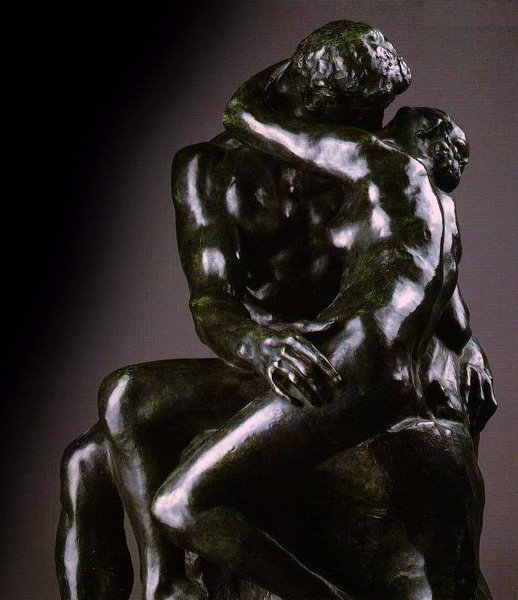
It's subject matter is fairly obvious: A couple locked in a kiss. The forms are, as always with my work, naturalistic and expressive, conveying the depth of the intense emotions the lovers feel. But now time for a little backstory. Wikipedia provides a nice summary of the story (if you let me go into it, I would never manage to talk about the work):
The sculpture, The Kiss, was originally titled Francesca da Rimini, as it depicts the 13th-century Italian noblewoman immortalised in Dante's Inferno (Circle 2, Canto 5) who falls in love with her husband Giovanni Malatesta's younger brother Paolo. Having fallen in love while reading the story of Lancelot and Guinevere, the couple are discovered and killed by Francesca's husband. In the sculpture, the book can be seen in Paolo's hand. The lovers lips do not actually touch in the sculpture to suggest that they were interrupted and met their demise without their lips ever having touched.I fell that in a way, this sculpture is a homage to women everywhere. Look at the lovers: the female is equal to the man, neither of less weight than the other in the perfect harmony of their love. Yes, women can be equal to men. So stop complaining that you don't get enough respect in artwork.
It's not one of my favorite works, though, to be honest. Recall what I said about it in earlier days:
The embrace of The Kiss is undoubtedly very attractive, but I have found nothing in this group. It is a theme frequently treated in the academic tradition, a subject complete in itself and artificially isolated from the world surrounding it; it is a big ornament sculpted according to the usual formula and which focuses attention on the two personages instead of opening up wide horizons to daydreams.I based it off one of the small figure groups from The Gates of Hell.* Remember how each figure group was seemingly isolated from the rest, never to achieve true unity with its surroundings? This was achieved by the use of pre-made parts and piecing them together (in a way) with The Gates of Hell. Here I would suppose the figures are too lost in their own world to pay attention to the space around them. It's an interesting conflict - or maybe non-conflict and complete non-interest - between the "inner space" of our emotions and the "outer world" around us. But still, can't you just feel the sheer delight and love of the two partners emanating from the sculpture? That's what someone said to me when he saw it. I'm glad that my work inspires such responses in viewers. Does it in you?
*Well, it was intended for use in The Gates of Hell at first. I eventually replaced them with another couple.
Here's another version in white marble.


 This is The Gates of Hell. Pleasant image, isn't it. Do you feel a sense of fragmentation in this work? Do you know why?
